

Study in Singapore Education Consultant: A Complete Guide for Indian Students
Planning to study abroad is an exciting decision, but it also brings many questions. Which university should you choose? Are you eligible for the course? How much will tuition and living expenses cost? Do you need IELTS? What documents are required? How does the Singapore Student's Pass process work?
Singapore can be an option for Indian students looking for higher education in a highly international environment. The country has universities, polytechnics, private education institutions and other post-secondary pathways, with different admission rules and programme structures.
For students looking for a Study in Singapore Education Consultant, professional guidance can help organise research, applications and documentation. However, students should always verify important admission, fee and immigration requirements with the institution and official Singapore authorities.
For students based in Lucknow, My Mentor provides study-abroad guidance and application-related support. Its website also has a dedicated study-abroad service page covering areas such as course and university shortlisting, documentation, applications, scholarships, accommodation and visa documentation support.
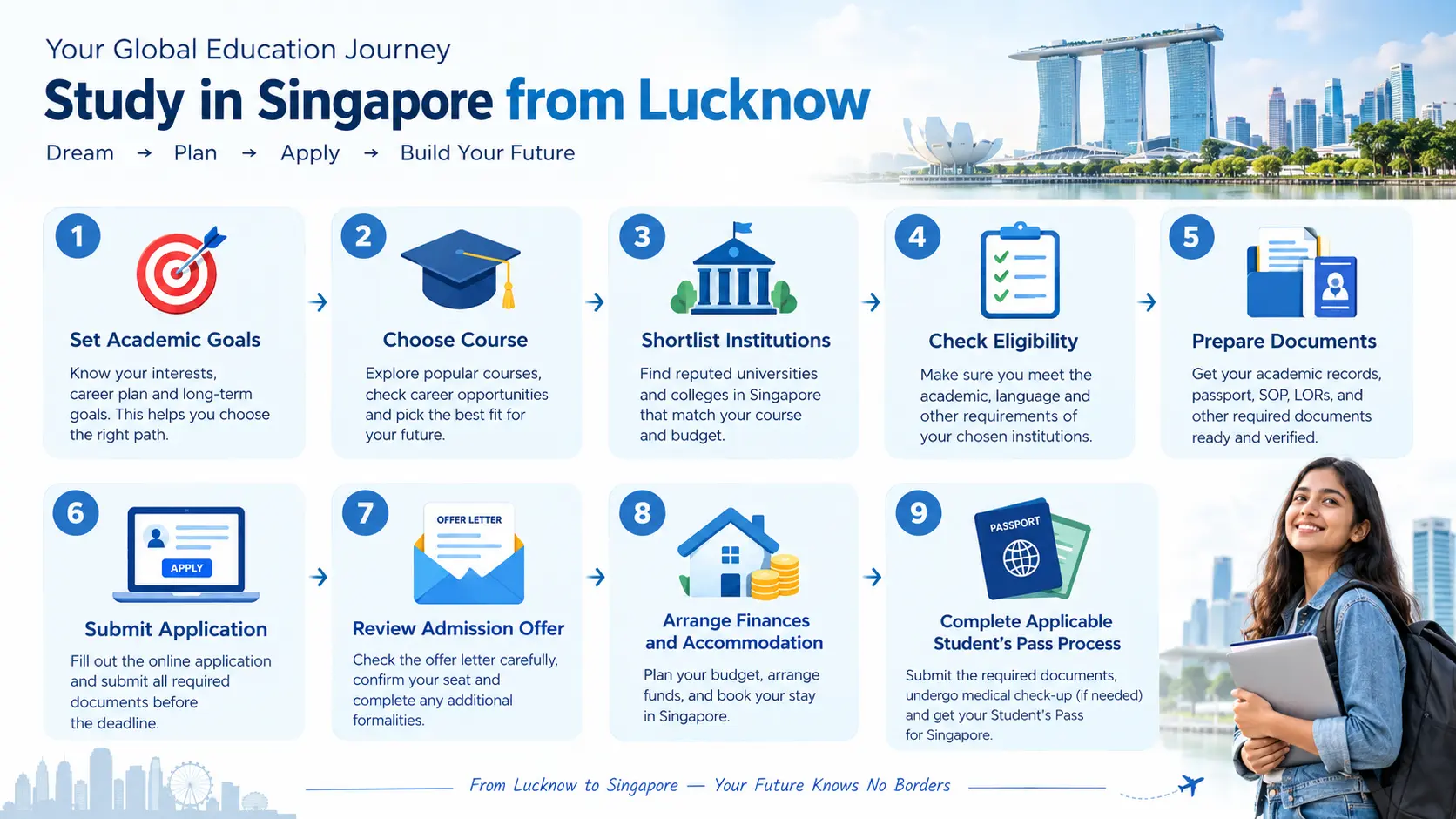
To study in Singapore from India, first identify your academic and career goals, shortlist suitable institutions, check the exact entry requirements, prepare your documents, submit applications before the relevant deadline, plan your finances and accommodation, and follow the applicable Student's Pass process.
How to Study in Singapore from Lucknow: Step-by-Step Process
If you are planning to Study in Singapore from Lucknow, the process can be organised into the following stages.
1. Identify your academic and career goals
Decide what you want to study and whether you are applying after Class 12, graduation or another qualification.
2. Shortlist suitable courses and institutions
Compare courses based on curriculum, duration, entry requirements, fees, location and your long-term plans.
3. Check eligibility
Read the official admission requirements for every shortlisted programme.
Requirements can vary significantly between institutions and courses.
4. Prepare documents
Start collecting academic records, passport documents, test scores and other supporting documents well before the deadline.
5. Submit applications
Complete the application carefully and submit all required documents before the institution's stated deadline.
6. Review your offer
If you receive an offer, carefully check the course, conditions, tuition fee information and deadlines.
7. Arrange finances and accommodation
Prepare a realistic budget covering tuition, accommodation, food, transportation, insurance and personal expenses.
8. Follow the Student's Pass process
Eligible international students accepted for full-time study generally need a Student's Pass unless an applicable exemption applies. ICA provides different procedures depending on the type of educational institution.
9. Prepare for departure
Complete accommodation, travel, financial, health and other pre-departure arrangements before travelling.
Eligibility Requirements for Indian Students
There is no single eligibility rule for every Singapore institution.
Study in Singapore after Class 12
Students applying for undergraduate programmes generally need an acceptable Class 12 or equivalent qualification and must meet the academic and subject requirements of the selected programme.
For example, NTU has a specific admissions route for India Standard 12 applicants. Its current published requirement states a minimum of 90% in all subjects including English, excluding other languages and certain technical subjects. NTU also states that meeting minimum requirements does not guarantee admission because admission is competitive.
SMU similarly publishes specific requirements for Indian Standard 12 qualifications, including a minimum of 90% for five subjects including English for its stated application route.
These figures are examples of institution-specific requirements, not a universal Singapore admission rule.
Study in Singapore after graduation
Postgraduate applicants normally need an appropriate bachelor's degree or equivalent qualification, but the exact academic background, grades, tests, work experience and other requirements depend on the university and programme.
Diploma and other programmes
Diploma and other eligible programmes can have their own admission criteria. Singapore's education system includes polytechnics and other post-secondary institutions, and students should check the exact institution and programme requirements.
English-language requirements
IELTS is not automatically required for every student or every institution.
Some universities accept or require particular English-language qualifications depending on the applicant's previous education and programme.
For example, NTU specifies different English-language requirements for certain India Standard 12 applicants depending on whether English was the medium of study.
Therefore, always check the official requirements of the course you want to apply for.
Best Universities and Institutions in Singapore
Students researching Singapore universities for Indian students can begin by looking at institutions such as:
National University of Singapore (NUS)
NUS is a comprehensive university offering programmes across multiple academic disciplines. International applicants should check the university's current programme-specific admission requirements and fees.
Nanyang Technological University (NTU)
NTU offers a wide range of undergraduate programmes and publishes separate admission information for international qualifications, including India Standard 12.
Singapore Management University (SMU)
SMU offers programmes including business, accountancy, economics, computing, information systems, social sciences and law. Its international qualification requirements should be checked for the specific programme.
Singapore University of Technology and Design (SUTD)
SUTD focuses on technology, design and interdisciplinary education. Its international admission requirements state that applicants should have completed at least 12 years of general education or taken the relevant Year 12 national/international examination.
Polytechnics and other institutions
Singapore also has five polytechnics: Nanyang Polytechnic, Ngee Ann Polytechnic, Republic Polytechnic, Singapore Polytechnic and Temasek Polytechnic.
The important point is that institutions differ. Do not select a university simply because it is popular. Compare the exact course, eligibility, fees and academic environment.
Cost of Studying in Singapore for Indian Students
The total cost depends heavily on the university, programme, accommodation and lifestyle.
Major expenses include:
- Tuition fees
- Accommodation
- Food
- Public transport
- Health insurance or medical costs where applicable
- Books and study materials
- Personal expenses
- Application-related fees
- Immigration-related fees
Tuition fees
There is no universal tuition fee for international students.
For example, NTU's published AY2026 tuition table shows different annual rates depending on programme category, nationality and whether a student receives the MOE Tuition Grant.
SMU's AY2026/27 published fees show that other international students receiving subsidised fees pay S$26,200 annually for several listed bachelor's programmes, while non-subsidised fees are higher. Law has separate fee levels.
SUTD's AY2026 published tuition table also distinguishes subsidised and non-subsidised fees for international students.
These figures demonstrate why students should calculate costs using the actual university and programme rather than relying on a generic "Singapore study cost".
Living expenses
Living expenses also vary according to accommodation and lifestyle.
An NUS estimate gives monthly living costs of approximately S$1,150–S$2,050 for on-campus students and S$1,550–S$3,400 for off-campus students in its published sample budget.
Students should treat these as planning estimates rather than fixed prices.
Scholarships and Financial Aid in Singapore
Indian students can investigate:
- University scholarships
- Institution-specific awards
- MOE Tuition Grant-related opportunities
- Scholarships linked to particular programmes
- Other eligible funding options
The MOE Tuition Grant can reduce subsidised tuition fees for eligible international students at participating institutions, but availability and conditions vary.
For example, SUTD states that eligible international students may apply for the Tuition Grant and that successful international recipients are required to work for a Singapore entity for three years after graduation. The number of grants available to international students is limited and selection is competitive.
Students should carefully read the conditions before accepting any funding or grant.
Singapore Student Visa / Student's Pass Requirements
A common point of confusion is the difference between a Singapore entry visa and a Student's Pass.

According to Singapore ICA, a foreigner accepted for full-time studies generally needs a Student's Pass unless they hold an applicable immigration status or qualify for an exemption.
For Institutes of Higher Learning, ICA states that the Student's Pass application is submitted online and should generally be made at least two months and not more than three months before the course begins. ICA also lists a non-refundable S$45 processing fee for the application.
After approval, ICA's completion-of-formalities guidance states that a S$60 Student's Pass issuance fee applies, with a S$30 Multiple Journey Visa fee where applicable.
Students should check the latest ICA instructions because immigration procedures and fees can change.
Importantly, a university offer does not mean that a Student's Pass is automatically guaranteed. The immigration authority makes the relevant decision.
Documents Required to Study in Singapore
The exact checklist depends on the institution, course and application stage.
Common documents may include:
- Valid passport
- Class 10 and Class 12 marksheets/certificates
- University transcripts
- Degree certificates
- English-language test results, if required
- Statement of purpose/personal statement, if required
- Letters of recommendation, if required
- CV, where required
- Passport-size photograph
- Admission or offer documents
- Financial documents, where requested
- Student's Pass-related documents
For example, ICA's higher-education Student's Pass guidance asks for information including the Registration Acknowledgement Letter, travel document details, educational background, financial support information, Singapore residential/contact information and a recent digital photograph.
Always use the official checklist provided by your university and ICA.
Intakes, Deadlines and Application Planning
Singapore does not have one universal application deadline for every university.
Deadlines vary by:
- University
- Course
- Qualification
- Intake
- Applicant category
For example, NTU's published international qualification schedule has different application windows and document deadlines depending on the qualification category.
SUTD also publishes qualification-specific application periods. Its 2026 application window for several international qualification routes was 2 January to 2 March 2026, with applications for 2026 now closed.
This is why students should start planning well ahead of their intended intake.
Common Mistakes to Avoid When Applying to Singapore
1. Choosing a course without checking eligibility
A course may require specific subjects, grades or qualifications.
2. Trusting admission guarantees
No consultant should promise guaranteed university admission.
3. Ignoring the total cost
Tuition is only one part of the budget. Accommodation, food, transportation and personal expenses can significantly affect the total cost.
4. Missing application deadlines
Late applications may not be accepted.
5. Submitting inaccurate documents
All academic and personal information should be accurate and verifiable.
6. Assuming admission guarantees a Student's Pass
University admission and immigration approval are separate processes.
7. Failing to verify institution details
Before paying fees, verify the institution, course, programme duration, tuition fee and relevant regulatory information using official sources.
Why Consider My Mentor for Study Abroad Guidance?
My Mentor's website currently lists study-abroad support including country, college and course shortlisting, documentation support, application review and submission, offer letters and scholarships, accommodation booking, education loans, visa documentation and filing, and post-visa services.
For students in Lucknow, this can be useful when the application process involves multiple stages and documents.
My Mentor also has a dedicated Study in Singapore for Indian Students article, which can serve as a supporting resource for students researching the destination.
Students should still verify programme requirements, tuition fees, scholarships and immigration rules directly with the relevant university and Singapore authorities.
Interested in studying in Singapore from Lucknow?
Students and parents can visit the My Mentor website to explore study-abroad guidance and enquire about the support available for their individual profile. Explore My Mentor study-abroad guidance or contact My Mentor to discuss your plan.
Frequently Asked Questions
1. How can I study in Singapore from Lucknow?
Start by identifying your preferred course, checking university eligibility, preparing documents, submitting applications before the relevant deadline, arranging finances and accommodation, and completing the applicable Student's Pass process.
2. Which are the best Singapore universities for Indian students?
Students can research institutions such as NUS, NTU, SMU and SUTD, along with other universities, polytechnics and eligible institutions. The right choice depends on your course, eligibility, budget and academic goals.
3. How much does it cost to study in Singapore?
There is no single cost for every student. Tuition varies by institution and programme, while living expenses depend on accommodation and lifestyle. Students should prepare a university-specific budget.
4. Is IELTS required to study in Singapore?
Not necessarily. English-language requirements differ between universities, programmes and previous educational backgrounds. Check the official requirement of your selected course.
5. What are the eligibility requirements for Indian students?
Requirements depend on the institution and programme. Undergraduate applicants may need Class 12 qualifications and subject-specific prerequisites, while postgraduate applicants normally need a relevant bachelor's qualification and any additional requirements specified by the university.
6. Do Indian students need a Student's Pass to study in Singapore?
International students accepted for eligible full-time study generally need a Student's Pass unless an applicable exemption applies. ICA provides the official requirements and application process.
7. Can Indian students get scholarships in Singapore?
Yes, some universities and institutions offer scholarships or financial support to eligible international students. Availability, eligibility and conditions vary, and awards can be competitive.
8. How do I choose a Singapore education consultant in Lucknow?
Look for transparent services, clear fees, realistic communication, proper documentation support and a willingness to show official university and immigration information. Avoid consultants who promise guaranteed admission or visa approval.
9. When should I apply to Singapore universities?
Apply according to the official deadline of your selected university and programme. Start early enough to prepare academic documents, English tests, financial planning, applications, accommodation and immigration formalities.
10. Can an education consultant guarantee admission or a Student's Pass?
No. Consultants can provide guidance and application support, but the university decides admission and the relevant Singapore authority decides immigration matters.
Conclusion
Studying in Singapore can be an important academic and financial decision for an Indian student. The process becomes easier to manage when you break it into clear stages: identify your goals, compare courses, verify eligibility, prepare documents, apply before deadlines, calculate your complete budget and follow the official Student's Pass requirements where applicable.
Students from Lucknow can also seek professional study-abroad guidance when they need help with course research, applications, documentation or pre-departure planning.
Most importantly, do not rely on generic promises. Verify university requirements, current fees, scholarship conditions and immigration rules using official sources before making decisions.
If you are planning to Study in Singapore from Lucknow, visit My Mentor to explore available study-abroad guidance and discuss your individual academic plans.